
Would This Survive 30 Services? Replacing Per-App Kustomize With One Helm Chart
I’ve been building argo-auto-promote, a small GitOps demo: two services, promoted dev → stage → prod by pinning an image tag, synced by Argo CD. It worked. Then I asked myself the question that actually matters for anything meant to resemble real infrastructure: would this survive 30 services?
The honest answer was no. Here’s what that boilerplate looked like, and what replaced it.
Before: what one service cost
Every service needed, per environment:
repo/base/service-a/
  deployment.yaml
  service.yaml
  kustomization.yaml
…plus, in every one of four overlays, an images: entry:
images:
  - name: service-a
    newTag: "0.0.1"
and so much more values…when it’s real production configs
…plus a replacements: block, because the container’s IMAGE_TAG env var needed to match whatever tag images: had just pinned, and Kustomize has no built-in way to reference “the value I just set two lines up” — so it reads it back off the Deployment’s own rendered image: field instead:
replacements:
  - source:
      kind: Deployment
      name: service-a-app
      fieldPath: spec.template.spec.containers.[name=service-a-app].image
      options: {delimiter: ":", index: 1}
    targets:
      - select: {kind: Deployment, name: service-a-app}
        fieldPaths:
          - spec.template.spec.containers.[name=service-a-app].env.[name=IMAGE_TAG].value
…plus, for the two environments that got a URL, a VirtualService file and a JSON6902 patch per environment to set its hostname, and one more hand-added rule in a single shared, hand-maintained Ingress file.
None of that loops. Kustomize has no concept of “repeat this for every service in a list” — every one of those blocks gets copy-pasted, by hand, per service, per environment. Two services already meant duplicating the replacements: block eight times across four overlay files.
Thirty services would mean roughly 240 near-identical blocks, (cry) each one a chance to typo a container name and quietly break IMAGE_TAG for one specific service in one specific environment, with no automated way to notice.
After: one chart, tiny values files
Everything service-specific moved into helm template (helped by my trusty CLAUDE assistant friend); everything actually specific to one service shrank to about eight lines: (caveat that this might be complicated or dangerous for real production configs, but one should test the templating process separately, before applying to actually cluster)
# chart/services/service-a/stage.yaml
name: service-a
image:
  repository: service-a
  tag: "0.0.1"
env:
  SERVICE_B_URL: http://service-b
route:
  enabled: true
  env: stage
The replacements: trick disappears entirely, because a Helm template can just reference the same value twice:
# chart/templates/deployment.yaml
containers:
  - name: {{ .Values.name }}-app
    image: "{{ .Values.image.repository }}:{{ .Values.image.tag }}"
    env:
      - name: IMAGE_TAG
        value: "{{ .Values.image.tag }}"   # same source, no readback needed
Adding service #31 is: write its four values files, add one line to a list. Nothing about the chart, the Deployment shape, or the routing logic needs to change or even be looked at.
The two things that weren’t a straight port
The Gateway. In the old setup, every env overlay bundled the whole system into one Application, so a per-env copy of the shared Gateway lived naturally alongside it. Moving to one Application per (service, env) pair means there’s no longer an env-level owner for a shared resource — so the Gateway now lives once, permanently, in istio-system, and every service’s VirtualService references it by its qualified name, istio-system/sample-gateway, instead of an unqualified same-namespace name.
The Ingress. A core Kubernetes Ingress’s backend service has to live in the same namespace as the Ingress itself — and istio-ingressgateway lives in istio-system, not in each service’s sample-<env> namespace. So each service’s chart render creates its own small Ingress, explicitly namespaced to istio-system:
{{- if .Values.route.enabled }}
apiVersion: networking.k8s.io/v1
kind: Ingress
metadata:
  name: {{ .Values.name }}-{{ .Values.route.env }}
  namespace: istio-system
{{- end }}
That name has to include the env, not just the service — every environment’s Ingress lands in the same namespace now, so service-a-dev and service-a-stage’s Applications would otherwise collide over one object. Missed that on the first pass; caught it rendering all eight (service, env) combinations with helm template before touching the live cluster, not after.
Traefik (this cluster’s ingress controller) merges routing rules from every Ingress matching its class, so thirty small Ingress objects behave identically to one big hand-maintained one — without anyone hand-maintaining it.
Promotion got more honest, not just shorter
The old setup’s images: block having one entry per service meant service-a and service-b could already be promoted independently — but promote.sh and the CI workflow both still pinned every service to the same tag value, because that’s what the single-overlay-per-env structure made easy.
With a matrix ApplicationSet (services x envs) generating a separate Application per pair, independent promotion stopped being a “you could, but” and became the only way it works: promote.sh service-a 0.0.2 touches exactly service-a’s three values files, full stop.
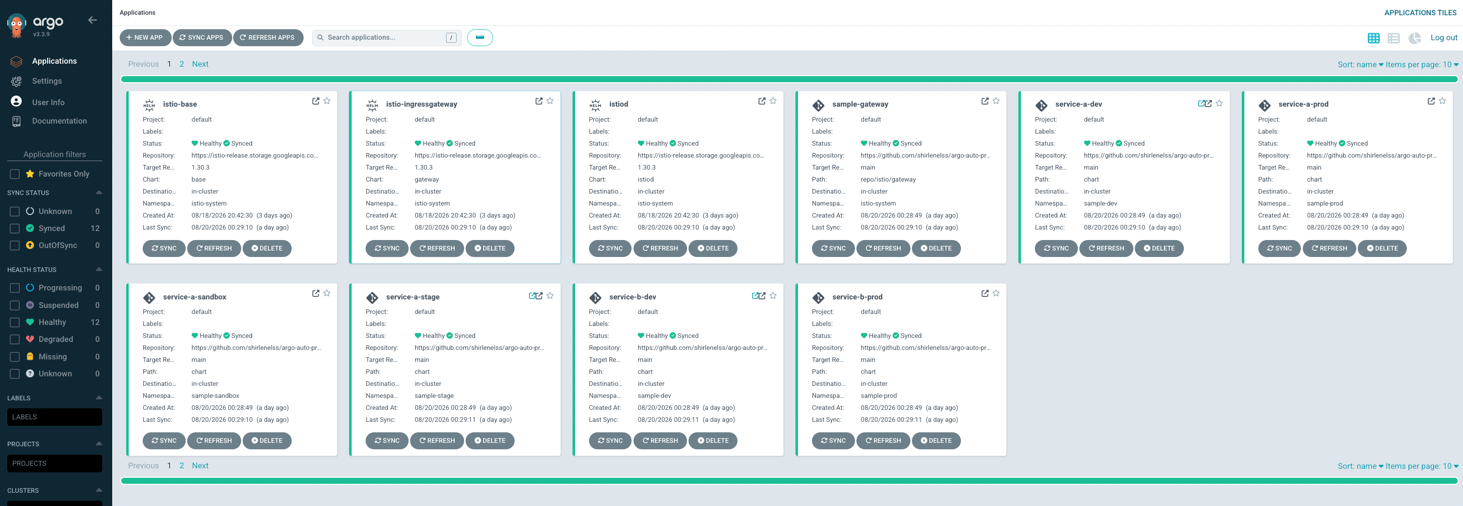
What actually broke during the swap
Two things, both caught by checking rather than assuming:
- The old
Applicationthat deployed the shared TraefikIngresspredated theresources-finalizer.argocd.argoproj.iopattern the newer ones use, so deleting it left an orphanedIngresssitting in the cluster instead of cascading away.kubectl get ingress -n istio-systemafter the swap showed it immediately; onekubectl deletecleaned it up. helm templatefor every(service, env)combination, before deploying anything, is what caught theIngressnaming collision above – rendering the actual full matrix, not just spot-checking one environment, is what makes “would this survive 30 services” answerable instead of hopeful.